Navigating MOQs and Lead Times: Tips for Working with a Kids T-Shirt Factory
A kids T-shirt factory can sound simple to evaluate until MOQ, sampling, fabric choices, printing, and delivery dates start pulling your project in different directions. Many buyers ask for the lowest MOQ first. That is understandable, but it can create hidden pressure on cost, quality, and schedule. A better approach is to judge MOQ by total production value.
When working with a kids T-shirt factory, MOQ should not be viewed only as the lowest order number. The right MOQ depends on fabric availability, color count, size range, printing method, customization level, quality expectations, and launch timeline. A slightly higher MOQ can sometimes improve unit cost, production stability, and quality consistency.
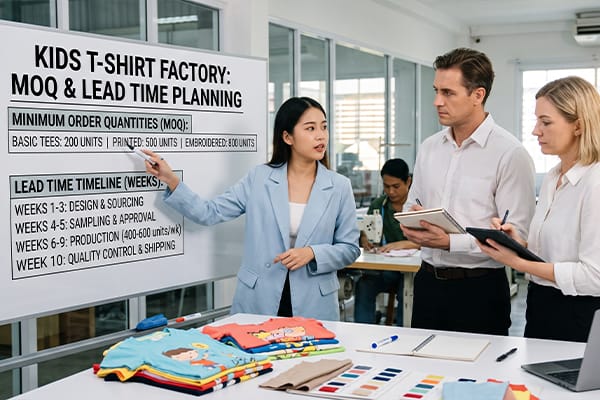
In my daily communication with overseas children’s clothing brands, I often see the same pattern. A buyer asks, “What is your lowest MOQ?” before sharing the design. A reliable factory usually needs more context first because MOQ and lead time are connected to real production details.
Why Is MOQ More Than a Number When Choosing a Kids T-Shirt Factory?
MOQ becomes frustrating when it feels like a factory rule with no explanation. Buyers want flexibility, especially when they are testing a new collection. However, if the MOQ is pushed too low, the project may lose fabric options, cost efficiency, or quality control stability.
MOQ is the minimum order quantity a factory needs to produce a style efficiently and consistently. For a kids T-shirt factory, MOQ is affected by fabric sourcing, dyeing, size grading, printing setup, trims, packaging, and production line planning. The best MOQ is the one that supports both brand testing and reliable manufacturing.
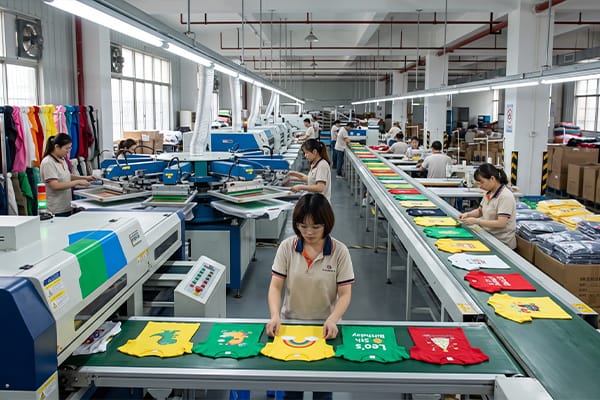
MOQ is connected to production reality
In many custom kids’ T-shirt projects, MOQ is not an arbitrary barrier. It reflects how materials and production steps work together.
For example, a simple blank T-shirt in stock fabric may be easier to produce in a smaller quantity. A fully custom organic cotton T-shirt with Pantone dyeing, puff printing, custom neck labels, hangtags, and private packaging usually needs a higher quantity to make sense.
Here are the main variables that affect MOQ:
- Fabric type: Organic cotton, bamboo, hemp, linen, and lyocell may have different availability.
- Fabric color: Custom dyeing usually requires higher fabric quantities than stock colors.
- Size range: A style with 2 sizes is easier to balance than a style with 8 sizes.
- Print or embroidery method: Screen printing, digital printing, puff printing, and embroidery all have different setup needs.
- Artwork placement: Front print only is simpler than full-print or multi-position artwork.
- Trims and packaging: Custom labels, care labels, hangtags, and bags add setup steps.
- Fit and construction: Oversized streetwear fits may require extra pattern development and testing.
Very low MOQ can help, but it has trade-offs
A low MOQ can be useful for a startup brand. It lets the brand test market reaction, reduce inventory risk, and launch a small capsule collection. I understand this because many new buyers are trying to protect cash flow.
However, a very low MOQ may create these limits:
| Buyer Goal | Possible Low-MOQ Limitation |
|---|---|
| More fabric options | Factory may need to use available stock fabric |
| Lower unit cost | Unit price may rise because setup costs are spread over fewer pieces |
| Custom colors | Pantone dyeing may not be practical in very small quantities |
| Premium decoration | Embroidery or screen setup may become expensive per piece |
| Full size range | Quantity per size may become too small for stable production planning |
| Fast delivery | Small custom orders still need sampling, approval, QC, and packing |
This is why I often suggest that buyers think beyond “lowest MOQ.” A better question is:
“What quantity gives my brand the best balance of cost, quality, customization, and delivery reliability?”
That question leads to a much better sourcing conversation.
When Can a Higher MOQ Create Better Value With a Kids T-Shirt Factory?
A higher MOQ may feel risky because it requires more upfront investment. Buyers worry about inventory, cash flow, and market testing. Those concerns are real. Still, in many custom T-shirt projects, a higher MOQ can improve cost performance and production consistency.
A higher MOQ can create better value when it spreads setup costs, improves fabric purchasing efficiency, supports more stable printing or embroidery, and helps the factory manage quality more consistently. With a kids T-shirt factory, the cheapest small order is not always the best commercial decision.
Higher MOQ can reduce the real unit cost
Custom kids’ T-shirts include more than fabric and sewing. Even a basic style can include many fixed or semi-fixed costs:
- Pattern making or pattern adjustment
- Sample development
- Fabric sourcing or dyeing
- Printing screen setup or digital file preparation
- Embroidery programming
- Label and hangtag preparation
- Cutting and production line arrangement
- Quality inspection
- Packing and carton preparation
When an order is small, those costs are divided across fewer pieces. The result is often a higher unit price. When the order quantity increases, the same setup work can be spread across more garments.
That does not mean every brand should order large quantities immediately. It means the buyer should compare total value, not only the lowest starting quantity.
Higher MOQ can support better quality consistency
Quality is one of the strongest reasons not to chase the lowest MOQ at all costs. In children’s apparel, consistency matters because parents care about comfort, durability, fit, and safety. For brands, consistency also protects reviews, repeat purchases, and brand image.
A more stable production quantity can help with:
- Fabric consistency: Larger fabric lots may reduce shade variation.
- Print consistency: Setup can be tested and adjusted before full output.
- Cutting accuracy: Layers and size ratios can be planned more efficiently.
- Sewing stability: Production lines can stay focused on one style longer.
- QC efficiency: Inspectors can compare a larger group of garments against the approved sample.
At Kids Wear Factory, our QC process usually includes fabric defect checks, shrinkage testing, color fastness attention, seam strength review, needle detection, and final inspection before shipment. Buyers should still verify required certificates and compliance documents based on their own market, especially for children’s products.
MOQ should match brand positioning
A boutique organic kidswear label is not competing only on price. It is often competing on feel, fit, design, sustainability, and trust. If a lower MOQ forces the brand to give up the fabric, color, or print quality that makes the product special, the low MOQ may not be worth it.
Here is a simple way to think about it:
| Brand Situation | Better MOQ Strategy |
|---|---|
| First market test | Choose a practical MOQ with limited colors and focused sizes |
| Premium organic basics | Use MOQ that supports better fabric sourcing and stable quality |
| Graphic streetwear launch | Plan enough quantity to make printing setup cost-effective |
| Seasonal collection | Confirm launch date early and reserve production time |
| Mature brand reorder | Use sales data to improve size ratios and reduce unit cost |
The right MOQ is not always the highest number. It is the quantity that protects the product promise.
How Should Brands Read Lead Times for Custom Kids’ T-Shirts?
Lead time becomes stressful when buyers treat it as only bulk production time. A launch date can slip because sampling, revisions, approval, packing, or shipping were not included in the plan. This is common, especially when a buyer is developing a custom style for the first time.
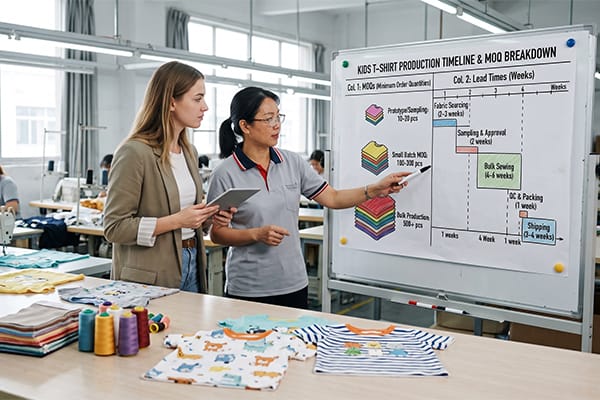
Lead time for custom kids’ T-shirts should be separated into stages: inquiry clarification, quotation, sampling, revision, approval, bulk production, QC, packing, and shipping. Samples usually take about 7–15 days, while bulk production usually takes about 30–60 days, depending on fabric availability, order volume, complexity, and scheduling.
Lead time is a chain, not one number
When a buyer asks a kids T-shirt factory for lead time, the factory should clarify what stage the buyer means. Does the buyer mean sample time? Bulk production time? Time until goods leave the factory? Or door-to-door delivery time?
These are different timelines.
| Stage | What Happens | Typical Timing Reference |
|---|---|---|
| Inquiry clarification | Factory reviews design, fabric, size range, quantity, and decoration needs | Depends on buyer information |
| Quotation | Factory calculates cost based on specifications | Depends on project clarity |
| Sampling | Prototype or sample is developed | Usually about 7–15 days |
| Sample review | Buyer checks fit, fabric, print, and construction | Depends on buyer feedback speed |
| Revision | Factory adjusts fit, fabric, print, or details if needed | Depends on complexity |
| Approval | Buyer confirms final sample and order details | Depends on decision speed |
| Bulk production | Cutting, sewing, printing, finishing | Usually about 30–60 days |
| QC and packing | Inspection, needle detection, folding, labels, cartons | Depends on order volume |
| Shipping | Express, air, sea, railway, truck, or combined logistics | Depends on destination and method |
Sampling deserves enough time
Some buyers try to compress sampling because they want to launch quickly. I understand the pressure. However, sampling is the stage where many expensive mistakes can be prevented.
A good sample review should check:
- Fit: Does the T-shirt match the intended silhouette?
- Length and width: Does the style work for the target age group?
- Neckline: Is it comfortable and easy to wear?
- Fabric hand feel: Does it match the brand’s quality level?
- Print quality: Is the artwork sharp, soft, durable, and correctly placed?
- Shrinkage: Does the garment remain acceptable after washing?
- Construction: Are seams neat and strong?
- Branding: Are labels, hangtags, and packaging requirements clear?
For oversized kids’ T-shirts, fit approval is especially important. A fashion-forward oversized fit should look intentional, not simply too large. This is why I always prefer to confirm sample comments clearly before moving into bulk production.
Revisions affect the final timeline
One sample round may be enough for a simple project. More complex designs may need revisions. A buyer may change the fabric weight, adjust the shoulder width, move the print placement, or request a different neck rib. These changes are normal, but they add time.
This is why launch planning should include a buffer. If a brand has a fixed selling date, such as a holiday launch or back-to-school campaign, the factory should know that date early. Then both sides can work backward from the target delivery window.
A practical planning mindset looks like this:
- Confirm the target launch date.
- Choose the desired delivery date.
- Add shipping time based on method and destination.
- Add QC and packing time.
- Add bulk production time.
- Add sample and revision time.
- Add inquiry and quotation time.
This approach gives a more realistic view than asking only, “How fast can you produce?”
What Should You Prepare Before Asking a Kids T-Shirt Factory for MOQ and Lead Time?
A buyer may feel disappointed when a factory cannot give an instant MOQ or lead time. However, the factory may simply need more information. Without design, fabric, color, size, print, and packing details, any answer is only a rough guess.
Before asking a kids T-shirt factory for MOQ and lead time, prepare style references or tech packs, fit direction, fabric preferences, colors, size range, quantity per size, decoration requirements, artwork files, launch date, label and packaging needs, and shipping expectations. Clear information leads to faster and more accurate answers.
A complete inquiry saves time
In my experience, the best inquiries do not need to be perfect. Many startup brands do not have complete tech packs yet. That is fine. A strong reference image plus clear notes can still help the factory understand the direction.
A useful inquiry should include:
- Product type: Kids’ T-shirt, oversized tee, baby tee, long sleeve, raglan, etc.
- Style reference: Photos, sketches, or a tech pack.
- Fit direction: Regular, oversized, boxy, cropped, relaxed, streetwear-inspired.
- Fabric preference: Organic cotton, bamboo cotton, cotton jersey, rib, slub, etc.
- Fabric weight: If known, such as 180gsm, 220gsm, or 260gsm.
- Color plan: Stock colors or Pantone custom dyeing.
- Size range: For example, 2Y–8Y or 90–140cm.
- Estimated quantity: Total quantity and approximate quantity per size/color.
- Decoration: Screen print, digital print, puff print, embroidery, appliqué, wash, or full print.
- Artwork files: AI, PDF, PNG, PSD, or logo files if available.
- Branding: Neck label, care label, hangtag, sticker, custom bag, carton marks.
- Target date: Desired launch date or latest delivery date.
- Shipping destination: Country, city, or port.
- Compliance needs: Market requirements such as CPC, OEKO-TEX, GOTS, or other documents to verify.
Quantity per size matters
Many buyers say, “I want 100 pieces,” but they do not explain how many colors and sizes are included. This changes everything.
For example:
| Total Quantity | Colors | Sizes | Quantity Per Size/Color |
|---|---|---|---|
| 100 pcs | 1 color | 5 sizes | 20 pcs per size |
| 100 pcs | 2 colors | 5 sizes | 10 pcs per size/color |
| 100 pcs | 4 colors | 5 sizes | 5 pcs per size/color |
The same total quantity can become very different from a production planning point of view. More colors and sizes create more cutting, sorting, labeling, packing, and QC work. They can also increase the chance of imbalance, especially if the quantity per size is very small.
If a startup brand wants to keep the first order manageable, I often suggest simplifying the first drop:
- Start with 1–2 strong colors instead of many colorways.
- Focus on core sizes based on the target customer.
- Use one main artwork placement.
- Keep packaging practical during the first test.
- Save complex trims or multiple print methods for later orders.
This does not mean the product must be boring. It means the first order should be designed for manufacturability, quality, and learning.
Better preparation creates better negotiation
When a buyer provides clear details, the factory can suggest smarter options. For example, the factory may recommend a stock organic cotton fabric for a test order, then custom dyeing for a larger reorder. Or the factory may suggest digital printing for small artwork trials and screen printing when the quantity increases.
This is where a good factory partner adds value. The goal is not to force the buyer into the largest order. The goal is to help the buyer understand the trade-offs.
A clear conversation may compare:
- Lower MOQ with higher unit price
- Higher MOQ with better unit cost
- Stock fabric with faster development
- Custom fabric with stronger brand identity
- Simple print with lower setup cost
- Complex decoration with stronger visual impact
- Express shipping with faster delivery
- Sea freight with better freight economy
When both sides understand the project, MOQ becomes a planning tool rather than a source of conflict.
Frequently Asked Questions
What is a reasonable MOQ for custom kids’ T-shirts?
A reasonable MOQ depends on fabric, colors, sizes, printing, labels, packaging, and production scheduling. Buyers should avoid judging MOQ as one fixed number. A reliable factory will usually ask for design details before giving a realistic MOQ recommendation.
Why does a lower MOQ usually increase the unit price?
A lower MOQ spreads setup costs across fewer garments. Pattern work, sampling, printing setup, production planning, QC, and packing still require time. Because fewer pieces share those costs, the unit price often becomes higher than it would be for a larger order.
How long does sampling take for custom kids’ T-shirts?
Sampling usually takes about 7–15 days, depending on fabric availability and design complexity. Revisions can add time if the buyer changes the fit, fabric, artwork placement, print method, or construction details after reviewing the first sample.
How long does bulk production take after sample approval?
Bulk production usually takes about 30–60 days, depending on order volume, fabric availability, garment construction, decoration method, and factory scheduling. Buyers should also allow time for QC, packing, and shipping when planning a launch date.
Should startup brands always choose the lowest MOQ?
Startup brands should control inventory risk, but they should not chase the lowest MOQ at all costs. A very low MOQ may limit fabric choices, increase unit cost, and reduce customization efficiency. The better goal is to find the quantity that protects quality and supports market testing.
Conclusion
Working with a kids T-shirt factory is easier when MOQ and lead time are treated as production planning tools, not just numbers to negotiate. The lowest MOQ may help a new brand test the market, but the best MOQ should also support fabric choice, unit cost, quality consistency, and delivery reliability. If you are preparing a custom kids’ T-shirt project, send your style references, fabric ideas, quantity plan, artwork, and target date to Kids Wear Factory so we can help you evaluate practical options.