How to Choose a Custom Factory for Your Brand?
A wrong factory choice can turn a strong kidswear idea into delays, poor fit, weak fabric, and brand damage before the first launch.
I choose a custom factory by checking development ability, sampling process, fabric knowledge, quality control, communication, and bulk production consistency. I do not judge only by MOQ or unit price, because the real risk often appears after sampling starts.
I speak with kidswear brands every week, and I often see the same problem. A brand asks, “Can the factory make this?” That question is too small. The better question is, “Can the factory develop this product, control the details, and repeat it in bulk?” A custom factory is not only a sewing room. It is a production partner that must understand fabrics, fit, prints, labels, packaging, safety, and timing. I have seen simple designs become hard because the fabric shrank too much. I have seen strong artwork fail because the print method was wrong for the fabric. I have also seen brands choose the lowest quote and then spend more money fixing samples, labels, and delays. So I always look deeper before I trust a factory with a brand collection.
What Does Development Ability Really Mean?
A factory may say it can make clothes, but that does not mean it can turn a brand idea into a stable product.
I define development ability as the factory’s skill in reading design input, choosing workable materials, building samples, solving fit issues, and preparing the style for bulk production.
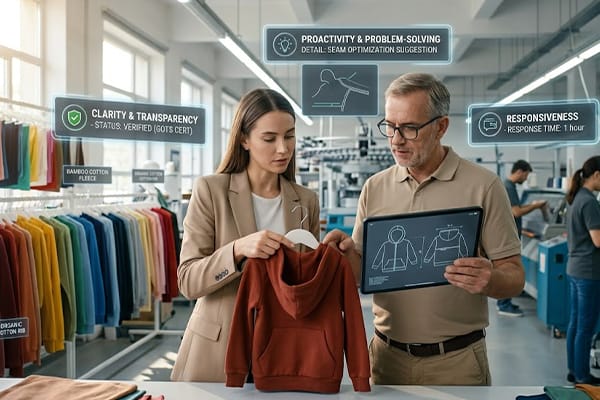
I look at how the factory reads the design input
In my daily work, some brands send full tech packs. Some brands send only reference photos, sketches, or mood boards. I do not judge either way. Both can work. But the factory must know how to turn that input into real production steps. For a custom kids’ T-shirt, I first confirm the body shape, fit, neckline, sleeve length, fabric weight, print size, and size range. If the style is oversized, I cannot use a normal basic T-shirt pattern. If the fabric is organic cotton jersey, I must think about shrinkage.1 If the print is large, I must check hand feel and wash resistance.
| What I Check | Why It Matters | Good Factory Response |
|---|---|---|
| Reference image or tech pack | It shows the design direction | The factory asks clear detail questions |
| Fabric choice | It affects comfort and shrinkage | The factory suggests real fabric options |
| Fit and sizing | It affects brand identity | The factory explains pattern changes |
| Print or embroidery | It affects cost and durability | The factory matches technique to fabric |
| Labels and packaging | It affects brand image | The factory plans trims before bulk |
A good custom factory does not only say yes. I think a better factory explains what can be done, what needs testing, and what may change during sampling. This is very important for startup brands, because many new brands do not yet know every production detail. I have often helped brands adjust print scale, fabric weight, or neck rib quality before the first sample. These small choices protect the final product.
Why Should I Not Choose Only by MOQ or Unit Price?
A low price can look safe at first, but it can create higher cost when sampling, quality, labels, packing, and delays are not clear.2
I treat MOQ and unit price as only part of the decision. I also check hidden risk, sample revision cost, fabric limits, QC process, and communication quality.
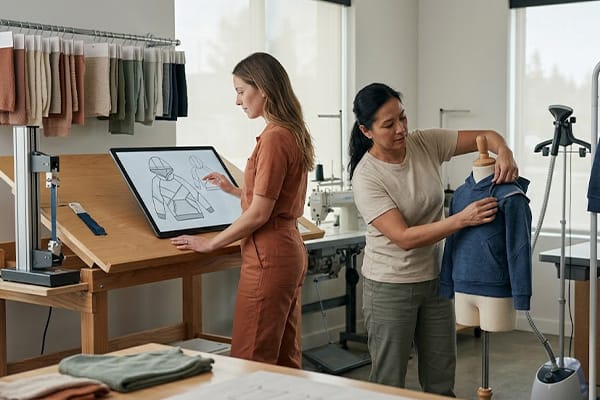
I compare total production risk, not only the first quotation
Many brands ask for the lowest MOQ and the lowest unit price. I understand this. A startup brand needs to protect cash flow. But I have seen low quotes hide real problems. The fabric may not be the same as requested. The label cost may be missing. The packaging may be basic. The print method may not match the design. The sample may need two or three revisions. The final price may change after the factory checks all details.
| Low Quote Area | Possible Hidden Issue | Question I Ask |
|---|---|---|
| Very low MOQ | Limited fabric or color choice | Is the fabric in stock or custom dyed? |
| Very low unit price | Lower fabric quality or simpler sewing | What fabric weight and construction are included? |
| Cheap printing | Weak wash result or rough hand feel | Which print method is used? |
| Free sample promise | Unclear revision rules | What happens if the fit needs changes? |
| Fast lead time | Weak planning or skipped checks | What is the real production schedule? |
I do not think a higher price always means better quality. That would be too simple. I think the quote must be complete. For kidswear, the factory should explain fabric, dyeing, printing, cutting, sewing, labels, packing, QC, and delivery timing.3 If a factory gives a quick number without asking about artwork size, fabric type, size range, or packing needs, I become careful. A serious quotation should connect to real product details. I would rather have a clear quote than a cheap quote that changes later.
What Should I Check for Kidswear Fabric and Safety?
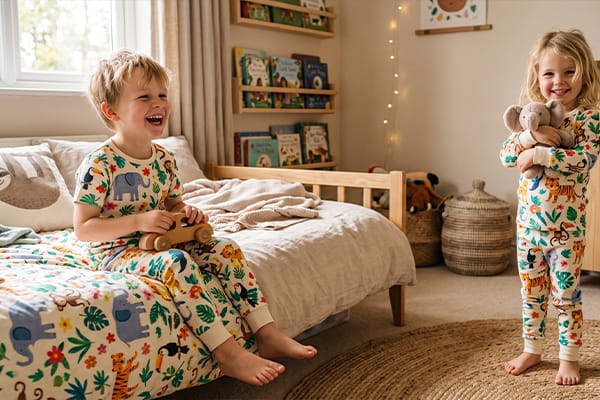
Kidswear is not only about looking cute or modern, because children need comfort, safe materials, strong seams, and stable fabric after washing.4
I check fabric composition, hand feel, shrinkage, color fastness, breathability, seam strength5, and standard awareness before I trust a factory with children’s apparel.
I treat fabric as the base of the whole product
In children’s clothing, fabric is never a small detail. A beautiful design can fail if the fabric is scratchy, unstable, or too thin. I often speak with brands that want organic cotton, bamboo, bamboo-cotton blends, hemp, linen, lyocell, or other sustainable fabrics. These materials can be strong choices, but each one behaves differently. Organic cotton can feel soft and natural. Bamboo blends can feel smooth. Linen can look premium but may wrinkle. Heavier jersey can support oversized streetwear shapes. Lighter fabric can work for summer basics.
| Fabric Point | Why I Check It | Practical Question |
|---|---|---|
| Composition | It affects comfort and brand claim | Is the fiber content clear? |
| Fabric weight | It affects drape and durability | Is it suitable for this style? |
| Shrinkage | It affects final size | Has shrinkage been considered? |
| Color fastness | It affects washing and rubbing | Is the dye stable enough? |
| Hand feel | It affects child comfort | Is it soft for daily wear? |
| Certification awareness | It affects market needs | Can the factory support needed documents? |
I am not a legal consultant, and I do not replace a brand’s own compliance review. But from the production side, I know the factory should understand common children’s apparel concerns. The factory should know that kidswear needs more care than adult fashion in many areas. Neck openings, drawstrings, small parts, trims, labels, and fabric finishing all need attention.6 I also ask how the factory checks fabric before cutting. If the fabric has defects, poor shrinkage, or unstable color, the problem becomes much harder after sewing.7 A strong factory catches many issues early.
How Do I Know If a Sample Proves Bulk Production Ability?
A good-looking sample can still hide risk, because one sample is easier to control than hundreds or thousands of bulk pieces.8
I judge a sample by fit, fabric, workmanship, print quality, measurement control, revision records, and how the factory plans to repeat the approved details in bulk.
I check the sample process and the bulk control plan
Sampling is a key stage, but it is not the end of factory evaluation. I have seen samples that looked acceptable, but bulk production still became unstable. This can happen when the sample fabric is not the same as bulk fabric. It can happen when the print is made by a different workshop. It can happen when the pattern revision is not recorded clearly. It can also happen when the approved sample is not used as the bulk production standard.
| Sample Check | What It Shows | What I Ask Before Bulk |
|---|---|---|
| Fit and measurements | Pattern accuracy | Are final size specs confirmed? |
| Fabric quality | Material match | Will bulk use the same fabric source? |
| Print or embroidery | Technique control | Is the approved artwork and placement locked? |
| Sewing quality | Workmanship level | What seam standard will bulk follow? |
| Label and packing plan | Brand detail control | Are trims confirmed before production? |
| Revision record | Process discipline | Are all changes written and shared? |
In my process, the first sample often focuses on the garment body, fabric feel, fit, and main design effect. Labels and packaging may be simplified in the first round. That is normal. But before bulk production, every detail must become clear. I want final artwork files, Pantone color references, size measurements, care label content, neck label position, hangtag plan, packaging method, and folding style. If a factory cannot explain how it moves from sample approval to bulk control, I do not think the sample alone is enough proof.
What Questions Should I Ask Before I Start Sampling?
Sampling can save time or waste time, and the difference often comes from the questions asked before the first prototype is made.
I ask about fabric availability, sample lead time, revision process, print method, size specs, MOQ, bulk lead time, label options, and QC steps before sampling begins.
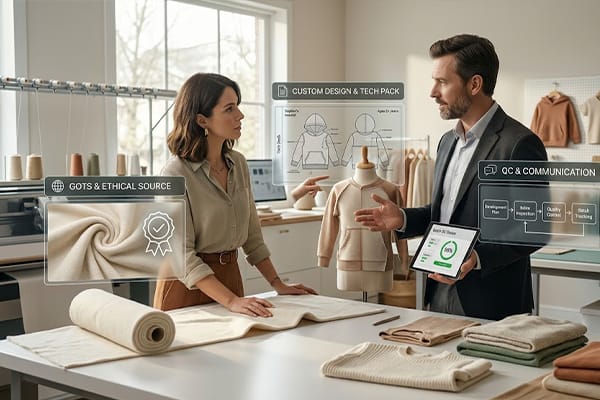
I prepare the sample brief before any cutting starts
A clear sample brief helps both the brand and the factory. I often tell brands that the first sample should answer specific questions. It should not be a random test. If the biggest concern is fit, I focus on measurements and pattern. If the biggest concern is fabric, I help compare fabric options first. If the biggest concern is artwork, I check printing technique, color, size, and placement. This keeps the sampling process more useful.
| Question Area | Question I Ask | Why It Helps |
|---|---|---|
| Style direction | Is this basic, oversized, or fashion-fit? | It guides the pattern |
| Fabric | Is the fabric in stock or custom sourced? | It affects time and MOQ |
| Color | Is the color stock or Pantone dyed? | It affects cost and schedule |
| Artwork | Is the file ready for production? | It affects print accuracy |
| Labels | Are brand labels needed for sample? | It affects sample detail |
| Revision | How many changes are expected? | It controls timeline |
| Bulk plan | What quantity may follow? | It guides fabric planning |
I have received many sample requests where the brand only sends one photo and asks for price. I can start from that, but I still need more information before a reliable sample can be made. For example, a vintage washed kids’ sweatshirt needs fabric weight, washing effect, rib quality, embroidery or print detail, and size range. A bamboo baby romper needs softness, snap quality, shrinkage thinking, and safe construction. When these questions are answered early, the sample becomes a real development step, not just a rough guess.
How Should I Judge Factory Communication?
Poor communication can damage a good design, because unclear answers create wrong samples, missed details, and production stress.
I judge factory communication by the quality of questions, speed of clear replies, written records, production updates, problem reporting, and willingness to explain tradeoffs.
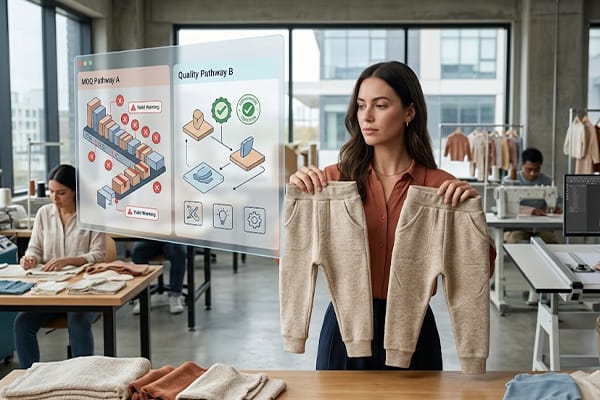
I watch how the factory handles unclear details
Communication is not only fast replies. Fast but empty replies do not help. I prefer clear replies that explain what is possible and what needs confirmation. In custom kidswear production, many small details matter. A neck label can be sewn in the wrong position. A print can move down by two centimeters. A fabric can be replaced without enough notice. A size chart can be misunderstood. Written communication protects both sides.
| Communication Signal | Weak Sign | Strong Sign |
|---|---|---|
| Questions before quote | Only asks quantity | Asks fabric, print, size, trims |
| Sample updates | No photos until shipping | Sends progress and issue updates |
| Problem handling | Hides issues | Reports issue and offers options |
| Revision control | Changes by memory | Uses written notes or updated files |
| Bulk production updates | Silent after payment | Shares key production stages |
| Final packing | No packing confirmation | Confirms labels, hangtags, cartons |
I have learned that a good production partner should not make the brand guess. If fabric is delayed, the factory should say it early. If the print may crack on a certain fabric, the factory should explain the risk. If the MOQ changes because of custom dyeing, the factory should explain why. I do not expect production to be perfect. Real production has limits. But I expect honest, practical communication. For international brands, this is even more important because the brand cannot visit the factory every week. Clear photos, samples, written approvals, and production records reduce mistakes.
How Can I Check Quality Control Before Bulk Production?
Quality control should not start after bulk production is finished, because many problems are already too late by then.9
I check whether the factory controls fabric, cutting, sewing, printing, measurements, needle safety, packing, and final inspection before shipment.
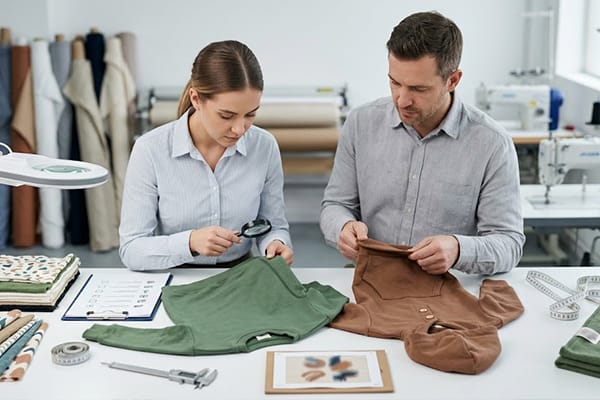
I want QC inside the full production flow
When I think about quality control, I do not only think about final inspection. Final inspection is important, but it cannot fix every problem. If fabric shrinkage is wrong, the garment may already be out of size. If cutting is poor, sewing cannot fully solve it. If the print color is wrong, packing inspection may only find the issue after money and time are already spent. So I prefer factories that check quality in stages.
| QC Stage | What I Want Checked | Why It Matters |
|---|---|---|
| Fabric arrival | Defects, color, hand feel | It prevents bad material use |
| Before cutting | Shrinkage and fabric direction | It protects measurements |
| Cutting | Size and panel accuracy | It affects fit consistency |
| Sewing | Seam strength and workmanship | It affects durability |
| Printing or embroidery | Placement, color, hand feel | It affects brand look |
| Finishing | Threads, stains, ironing | It affects customer experience |
| Final inspection | Measurements and packing | It protects shipment quality |
For kidswear, I also pay attention to durability. Children move, play, wash, pull, and stretch clothing more than adults may do. So the garment needs practical strength. I look at seams, rib recovery, print wash effect, and trims. I also believe needle detection and careful packing are important steps for many children’s apparel orders.10 A factory should be able to explain its QC process in simple terms. If the answer is only “we check quality,” I ask for more detail. I want to know when the checks happen, who checks them, and what happens if a problem is found.
Conclusion
I choose a custom factory by checking development skill, product safety, sampling discipline, clear communication, and bulk control before I compare price.
"An Investigation into the Dimensional Stability of 100 ...", https://www.academia.edu/42668212/An_Investigation_into_the_Dimensional_Stability_of_100_Cotton_Fleece_Knit_Fabric. Textile research on cotton knitted fabrics reports dimensional changes after washing and laundering, supporting the need to account for shrinkage when developing cotton jersey garments; the evidence is general to fabric behavior and not specific to the article’s factory process. Evidence role: mechanism; source type: paper. Supports: Cotton knit fabrics can undergo dimensional change during laundering, making shrinkage control relevant before production.. Scope note: Contextual support; shrinkage magnitude depends on yarn, knit structure, finishing, and laundering conditions. ↩
"[PDF] EFFECTIVE METHODOLOGIES FOR SUPPLIER SELECTION AND ...", https://etda.libraries.psu.edu/files/final_submissions/419. Procurement and supplier-selection research shows that total cost of ownership extends beyond quoted price to include quality, delivery, service, and risk-related costs, supporting the article’s caution against choosing a factory solely by low price; the evidence is general to sourcing decisions rather than children’s apparel specifically. Evidence role: general_support; source type: paper. Supports: Supplier selection research often distinguishes quoted price from total cost, including quality, delivery, and transaction or failure costs.. Scope note: Contextual support; it supports the sourcing principle but does not quantify hidden costs in kidswear manufacturing. ↩
"How Garment Manufacturing Works | TAQI UR REHMAN posted on ...", https://www.linkedin.com/posts/taqi-ur-rehman-02b10131a_textile-manufacturing-garments-activity-7341873257672765442-nHxB. Educational sources on garment manufacturing describe production as a sequence of material preparation, cutting, sewing, finishing, packing, quality control, and scheduling activities, supporting the article’s view that a quotation should cover these details; the source would not verify the completeness of any particular quote. Evidence role: general_support; source type: education. Supports: Garment manufacturing involves linked stages such as fabric preparation, cutting, sewing, finishing, packing, quality control, and scheduling.. Scope note: Contextual support; production stages vary by product type, decoration method, and factory organization. ↩
"[PDF] Textiles/Apparel - Consumer Product Safety Commission", https://www.cpsc.gov/s3fs-public/Session%204%20Textiles%20En.pdf. Government children’s product safety guidance and textile performance standards identify safety hazards and durability-related concerns relevant to children’s apparel, supporting the need to consider safe materials, construction strength, and wash stability; this provides a regulatory and technical context rather than a single unified rule for all garments. Evidence role: expert_consensus; source type: government. Supports: Children’s apparel is subject to safety considerations, and textile performance factors such as seams and laundering stability are relevant to use.. Scope note: Contextual support; requirements differ by jurisdiction, garment type, child age, and market. ↩
"List of Testing Methods Used in Textile Industry", https://www.textileflowchart.com/2025/06/list-of-testing-methods-used-in-textile-industry.html. Textile standards from bodies such as ASTM or ISO define methods for evaluating dimensional change, color fastness, air permeability, and seam strength, supporting the article’s use of these properties as quality-control criteria; the standards define measurement methods rather than prescribing one acceptable value for every children’s garment. Evidence role: definition; source type: institution. Supports: Textile standards bodies define test methods for dimensional change, color fastness, air permeability or breathability-related properties, and seam strength.. Scope note: Directly supports the relevance of the properties, but acceptable thresholds depend on product category and market requirements. ↩
"Drawstrings in Children's Upper Outerwear | CPSC.gov", https://www.cpsc.gov/Business--Manufacturing/Business-Education/Business-Guidance/Drawstrings-in-Childrens-Upper-Outerwear. Government children’s product safety guidance identifies risks from drawstrings, small parts, and certain garment components, supporting the article’s warning that these details require attention in kidswear; the guidance is jurisdiction-specific and should be supplemented with market-specific compliance review. Evidence role: expert_consensus; source type: government. Supports: Children’s apparel safety guidance identifies hazards involving drawstrings, small parts, and garment components, and regulatory frameworks address chemical or finishing risks.. Scope note: Directly relevant to safety categories, but exact legal obligations vary by country, age range, and product design. ↩
"Fabric inspection - Wikipedia", https://en.wikipedia.org/wiki/Fabric_inspection. Apparel manufacturing quality-control sources emphasize inspecting and testing fabric before cutting because material defects and dimensional or color problems can propagate through sewing and finishing, supporting the article’s preference for early detection; the evidence explains the process mechanism rather than documenting a specific factory outcome. Evidence role: mechanism; source type: education. Supports: Garment production guidance emphasizes fabric inspection and testing before cutting to prevent downstream defects and rework.. Scope note: Contextual support; the severity and recoverability of defects vary by fabric, garment construction, and order requirements. ↩
"System Performance and Process Capability in Additive Manufacturing", https://pmc.ncbi.nlm.nih.gov/articles/PMC7361965/. Quality-management literature distinguishes inspection of an individual prototype from evidence of stable process capability in repeated production, supporting the article’s claim that one good sample is insufficient proof of bulk consistency; the support is general manufacturing theory rather than garment-specific empirical data. Evidence role: general_support; source type: research. Supports: Quality management distinguishes prototype conformance from the ability of a production process to reproduce consistent outputs at scale.. Scope note: Contextual support; it does not quantify how often apparel bulk production deviates from approved samples. ↩
"The Ultimate Guide to Quality Inspection in Manufacturing - Six Sigma", https://www.6sigma.us/manufacturing/quality-inspection/. Quality-management frameworks such as ISO 9001 emphasize process control, monitoring, and corrective action throughout production, supporting the article’s claim that final inspection alone cannot prevent many defects; this is a general quality-system principle, not apparel-specific proof. Evidence role: expert_consensus; source type: institution. Supports: Quality-management frameworks emphasize process control, monitoring, and prevention rather than relying only on final inspection.. Scope note: Contextual support; implementation practices vary by factory size, product complexity, and certification status. ↩
"Understanding the 9-Point Needle Detection System in ...", https://www.linkedin.com/posts/yasin-m-76940425a_textilemanufacturing-qualitycontrol-needledetection-activity-7350898236884180994-jTuG. Apparel quality-assurance guidance commonly treats broken-needle control or metal detection as a safety measure and packing inspection as part of shipment quality control, supporting the article’s view that these steps can matter for children’s apparel orders; the relevance depends on buyer requirements and product risk level. Evidence role: general_support; source type: institution. Supports: Garment quality-assurance practices commonly include controls for broken needles or metal contamination, and packing checks help preserve product condition before shipment.. Scope note: Contextual support; not every jurisdiction mandates needle detection for all children’s garments, and requirements may be buyer- or market-specific. ↩