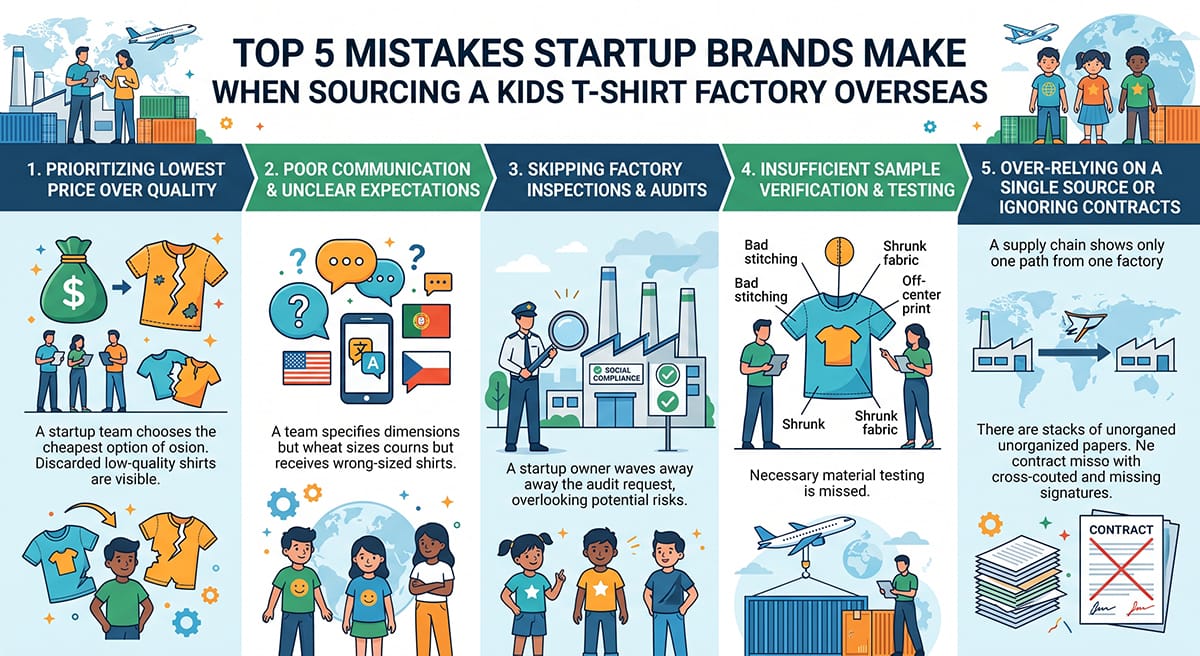
Top 5 Mistakes Startup Brands Make When Sourcing a Kids T-Shirt Factory Overseas
A kids T-shirt factory can look easy to compare at first. You ask for MOQ, price, and lead time. Then the problems start: unclear samples, wrong fabric feel, delayed launch dates, or bulk goods that do not match the approved sample. The better solution is to treat sourcing as product development, not just purchasing.
The biggest mistakes startup brands make when sourcing a kids T-shirt factory overseas are asking price too early, sampling with incomplete details, treating kids’ tees like adult tees, choosing the wrong factory fit, and approving samples without clear production standards. Each mistake increases the risk of delays, extra costs, and inconsistent bulk quality.
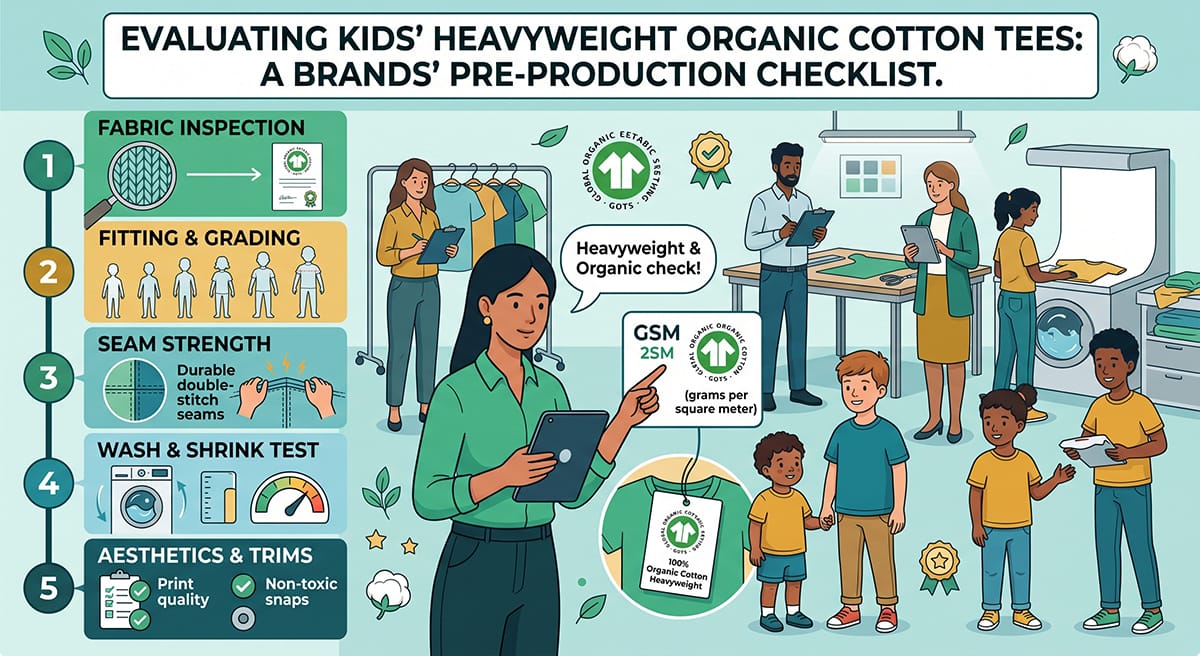
I have joined many early conversations with startup kidswear brands. Most founders have strong taste and good product ideas. The challenge is that overseas production rewards clarity. The more clearly you define the product before sampling, the easier it is for a factory to support you.
Mistake 1: Are You Asking a Kids T-Shirt Factory for Price Before Defining the Product?
Many startup brands begin with one question: “What is your lowest MOQ and price?” I understand why. Budgets are real. But when a kids T-shirt factory has no clear product details, any quote is only a rough guess. That guess can change later and create frustration.
A factory can quote more accurately when you define the fabric, GSM, fit, size range, print method, artwork, order quantity, quality expectations, and inspection requirements. Without these variables, the price may look attractive, but it may not reflect the product you actually want to sell.
Why this mistake causes sourcing problems
A kids’ T-shirt is a simple garment only on the surface. In production, several variables change the cost and result:
- Fabric type: organic cotton, bamboo, bamboo-cotton blend, hemp, linen, lyocell, or regular cotton
- Fabric structure: jersey, rib, interlock, waffle, or French terry
- Fabric weight: light summer jersey may feel very different from a premium heavyweight tee
- Fit: regular, oversized, boxy, cropped, longline, or drop-shoulder
- Size range: baby, toddler, little kids, or big kids
- Print technique: screen print, digital print, puff print, water-based print, embroidery, or appliqué
- Testing needs: shrinkage, color fastness, seam strength, needle detection, and market-specific labeling
I often see brands send a reference image and ask for a fast price. The factory then has to make assumptions. One factory may quote using basic cotton jersey. Another may quote with organic cotton. Another may include a premium print. These quotes are not comparable.
What should be prepared before asking for a quote?
You do not need a perfect tech pack in the first email. However, you should prepare enough details for a realistic quotation.
| Product Detail | Why It Matters for Quotation |
|---|---|
| Fabric composition | Affects cost, hand feel, shrinkage, and sustainability claims |
| Fabric weight/GSM | Affects price, drape, durability, and seasonality |
| Size range | Affects fabric consumption and grading work |
| Fit direction | Affects pattern development and sample accuracy |
| Print size and technique | Affects setup cost, labor, and production risk |
| Quantity per color/size | Affects MOQ planning and unit price |
| Quality expectations | Affects inspection process and acceptable tolerance |
For example, a 180 GSM organic cotton jersey T-shirt and a 220 GSM oversized tee made from 70% bamboo 30% organic cotton are not the same product. They may both be “kids’ T-shirts,” but they require different sourcing, costing, and sampling decisions.
Price is important, but unclear price comparison is not real sourcing.
If you want to reduce re-quotes, start with a product brief. Even a one-page brief helps. I usually suggest founders include reference photos, target retail price, fabric preference, size range, print idea, and preferred fit. This gives the factory enough direction to advise whether your product plan matches your budget.
Mistake 2: Are You Expecting Accurate Samples From Only a Logo or Reference Image?
A reference image can show style direction. A logo can show branding. But neither one tells a kids T-shirt factory overseas how the garment should fit, stretch, wash, print, or feel. When sampling begins with missing details, revisions become slower and more expensive.
Accurate sampling needs size specs, fabric direction, artwork files, print placement, fit expectations, color references, and construction notes. Some details, such as final hangtags or packaging, can often be confirmed later, but the core garment details should be clear before the first prototype.
What startups usually miss before sampling
In early sampling conversations, I often see founders send beautiful mood boards. That is a good start. However, production teams need technical information too.
Here are the most common missing items:
Size specification
- Chest width
- Body length
- Shoulder width
- Sleeve length
- Neck opening
- Hem width
Fabric direction
- Organic cotton jersey for a classic tee
- 95% bamboo 5% spandex for soft stretch basics
- 70% bamboo 30% organic cotton for a soft and more natural blend
- Heavier cotton jersey for streetwear-inspired oversized shapes
Artwork files
- Vector files such as AI, PDF, or EPS are usually better for logos
- High-resolution files are needed for digital prints
- Pantone references help with color communication
Print placement
- Center chest, full front, back print, sleeve print, or all-over print
- Exact distance from neckline or seam
- Print size by garment size if needed
Fit expectation
- A toddler oversized tee should not be graded like an adult oversized tee
- A drop-shoulder style needs different shoulder and sleeve balance
- A bamboo stretch tee needs different recovery expectations than cotton jersey
What can be finalized later?
Not every detail needs to be locked before the first sample. In our own development process, first prototypes often use simplified trims and packaging. This keeps sampling practical.
The following details can sometimes be finalized after fit and fabric approval:
| Detail | Can It Wait? | Notes |
|---|---|---|
| Hangtag design | Usually yes | Final before bulk production |
| Polybag design | Usually yes | Confirm size and warning text if required |
| Neck label artwork | Sometimes | Placement and label type should be discussed early |
| Care label content | Sometimes | Must match fabric and target market requirements |
| Final carton marks | Yes | Confirm before shipping |
However, the main garment should not be vague. Fabric, fit, measurements, and print effect are the foundation. If those parts are unclear, the sample will become a guess.
A strong sample request does not need to be complicated. It only needs to answer the questions that affect production. I usually tell new brands: “Give the factory enough detail to make the same product you are imagining.” That one mindset saves a lot of time.
Mistake 3: Are You Treating Kids’ T-Shirts Like Smaller Adult T-Shirts?
Adult T-shirt experience helps, but it does not fully transfer to children’s apparel. Kids move more, wash cycles are frequent, and comfort expectations are higher. A kids T-shirt factory must consider shrinkage, color fastness, safety, hand feel, and labeling requirements with extra care.
Kids’ T-shirts need child-specific sourcing judgment. Fabric softness, seam comfort, neck stretch, print safety, durability, and size grading all matter. Brands should also verify market-specific testing, labeling, and certification documents with the factory or qualified professionals before selling.
Why kidswear has different risks
Children’s clothing is sensitive because the wearer is not the buyer. Parents judge the product after repeated washing, touching, stretching, and daily use. A T-shirt may look perfect in a photo but fail in real life if the fabric becomes rough, the print cracks, or the neck opening loses shape.
Important kidswear factors include:
- Comfort against skin
- Breathability
- Shrinkage after washing
- Color fastness to washing and rubbing
- Print hand feel
- Seam strength
- Neckline recovery
- Label softness
- Needle detection
- Age-appropriate sizing
- Market-specific compliance
Fabric examples for children’s T-shirts
| Fabric Option | Common Use | Buyer Evaluation Point |
|---|---|---|
| Organic cotton jersey | Everyday premium kids’ tees | Softness, shrinkage, certification documents |
| 95% bamboo 5% spandex | Stretch basics and soft loungewear | Recovery, pilling, washing stability |
| 70% bamboo 30% organic cotton | Soft sustainable-feel tees | Hand feel, drape, color consistency |
| Cotton jersey | Classic printed T-shirts | Weight, print result, shrinkage |
| Heavyweight jersey | Oversized streetwear tees | Shoulder shape, drape, heat comfort |
If a brand wants a sustainable positioning, it should not only ask, “Do you have organic cotton?” It should also ask what documents are available, whether the material is suitable for the design, and whether the claim is appropriate for the selling market. Certifications such as GOTS, OEKO-TEX Standard 100, OCS, CPC, or BSCI-related documents should be treated as documents to verify, not as casual marketing words.
Prints need special attention
Prints are a major part of modern kidswear. They also create risk.
For children’s tees, brands should evaluate:
- Is the print soft enough for daily wear?
- Will the print crack after washing?
- Does the print method suit the fabric?
- Does the ink or process match target-market requirements?
- Will the print scale properly across sizes?
A puff print on a heavy oversized tee can look premium. The same print on a thin stretch bamboo tee may not behave the same way. A full-front digital print can look great, but the artwork resolution and fabric base must be correct.
This is why a kidswear-focused supplier matters. The factory should not only sew the T-shirt. It should help you think through whether the material, print, and fit make sense for children.
Mistake 4: Are You Choosing a Kids T-Shirt Factory Overseas Only Because the MOQ Is Low?
Low MOQ can help startups launch. I respect that. But MOQ alone does not tell you whether a kids T-shirt factory overseas can support your brand. A low entry quantity becomes risky if communication is slow, samples are unstable, or bulk quality cannot match approval.
A better factory choice should consider development support, communication efficiency, kidswear experience, sample-to-bulk consistency, lead-time stability, fabric sourcing ability, and reorder potential. The cheapest option is not always the safest option for a design-led children’s brand.
What “factory fit” really means
Factory fit is not only about product category. It is about whether the factory’s strengths match your brand’s needs.
A startup organic kidswear brand may need:
- Flexible MOQ starting around small batches
- Organic cotton and bamboo fabric sourcing
- Help with incomplete tech packs
- Clear sampling communication
- Strong quality control
- Private label support
- Reorder consistency
A streetwear-inspired kidswear brand may need:
- Oversized pattern development
- Heavyweight jersey sourcing
- Graphic print experience
- Puff print or embroidery ability
- Good color control
- Trend-aware development support
A basic mass-market supplier may not be wrong. It may simply not fit your product strategy. In the same way, a premium development-focused factory may not be the right fit for a brand that only wants the lowest possible price.
How to compare overseas kids’ T-shirt factories
Instead of only asking “What is your MOQ?”, ask better questions.
| Evaluation Area | Questions to Ask |
|---|---|
| Kidswear experience | Do you regularly produce children’s T-shirts? Which age ranges? |
| Fabric support | Can you source organic cotton, bamboo blends, and jersey options? |
| Sampling process | What information do you need before sampling? |
| Lead time | What is the sample lead time and bulk lead time? |
| QC process | Do you check shrinkage, color fastness, seams, and finished garments? |
| Print capability | Which print methods do you support for kids’ tees? |
| Branding | Can you support neck labels, care labels, hangtags, and packaging? |
| Reorders | Can you maintain fabric and color consistency for future orders? |
In my experience, reliable communication is one of the most underrated factors. A factory does not need to reply every minute. But it should answer clearly, ask useful questions, and explain trade-offs. If the factory only says “yes” to everything, you should be careful. Good production teams often ask detailed questions because they are trying to avoid mistakes before fabric is cut.
For startup brands, flexibility matters. But flexibility should be organized. A good supplier can guide you through what must be decided now and what can wait. This balance helps you move forward without losing control.
Mistake 5: Are You Approving Samples Without Clear Bulk Production Standards?
Sample approval feels exciting. It means the product is finally real. But if approval is vague, bulk production becomes risky. A kids T-shirt factory needs to know exactly what has been approved and what tolerance is acceptable before cutting and sewing the full order.
Sampling approval should cover fit, measurements, fabric, color, print effect, trims, label placement, workmanship, and acceptable tolerance. Brands should approve samples as a production control point, not only as a visual sign-off. Clear approval reduces sample-to-bulk inconsistency.
What does “approved” actually mean?
When a founder says, “The sample looks good,” I always want to know what “good” means. Does it mean the fabric is approved? Does it mean the fit is approved? Does it mean the print color is approved? Each part must be clear.
A strong approval process includes:
- Fit approval: The garment shape and wearing comfort are accepted
- Measurement approval: Key size points match the agreed tolerance
- Fabric approval: Composition, weight, hand feel, and color are accepted
- Print approval: Size, placement, color, texture, and technique are accepted
- Trim approval: Neck label, care label, and other trims are accepted
- Workmanship approval: Stitching, seams, neckline, and finishing are accepted
- Packaging approval: Folding, polybag, stickers, and carton details are accepted if applicable
Example approval checklist for kids’ T-shirts
| Approval Item | What to Confirm |
|---|---|
| Fabric | Organic cotton jersey, bamboo blend, GSM, hand feel |
| Fit | Oversized, regular, boxy, drop-shoulder, or slim |
| Measurements | Chest, length, shoulder, sleeve, neck opening |
| Artwork size, placement, technique, color, hand feel | |
| Color | Pantone reference or approved lab dip |
| Labels | Neck label, care label, size label |
| Quality tolerance | Measurement tolerance and workmanship standard |
| Testing | Shrinkage, color fastness, and required market checks |
Why tolerance matters
Garments are not metal parts. Fabric stretches, relaxes, shrinks, and behaves differently after sewing and washing. This is why acceptable tolerance must be discussed. For example, a small measurement difference may be acceptable in a cotton jersey tee, but a large neck opening difference can affect comfort and appearance.
Startups should also understand that sample fabric and bulk fabric must be controlled. If the sample uses available fabric and bulk uses newly dyed fabric, color and hand feel should be reviewed again. If the print method changes from sample to bulk, the print effect may change too.
Before bulk production starts, brands should ask:
- Is this the final approved fabric?
- Is the color approved by swatch or lab dip?
- Is the size spec final?
- Is the print placement final?
- Are labels and packaging confirmed?
- What tolerance will the factory follow?
- What QC checks will happen before shipment?
At Kids Wear Factory, our usual process includes sample development, revision if needed, and final confirmation before bulk production. I mention this not as a sales claim, but because this sequence is practical. It helps both the brand and the factory avoid confusion.
Sampling is not just a creative step. It is the bridge between your design idea and repeatable production.
Frequently Asked Questions
What should I prepare before contacting a kids T-shirt factory?
You should prepare reference images, fabric preferences, size range, fit direction, print artwork, estimated quantity, branding needs, and target market. A full tech pack is helpful, but not always required at the first step. Clear product direction helps the factory quote and sample more accurately.
What is a reasonable MOQ for custom kids’ T-shirts?
MOQ depends on fabric, color, print method, and customization level. Some factories support lower MOQs for startup brands, while special fabrics or custom dyeing may require higher quantities. At Kids Wear Factory, flexible MOQs can start from 100 pieces per style depending on the project details.
Which fabrics are popular for premium kids’ T-shirts?
Popular options include organic cotton, cotton jersey, 95% bamboo 5% spandex, and 70% bamboo 30% organic cotton. Each fabric has different softness, stretch, shrinkage, and cost characteristics. Brands should choose fabric based on fit, season, price position, and target customer expectations.
How long does kids’ T-shirt sampling usually take overseas?
Sampling often takes around 7–15 days depending on fabric availability, artwork, print technique, and design complexity. Shipping time is additional. If the first sample needs fit changes, print adjustment, or fabric replacement, the development timeline will become longer.
Do children’s T-shirts need testing or certification?
Testing and certification depend on your selling market, fabric claims, and product category. Buyers should verify documents such as GOTS, OEKO-TEX Standard 100, OCS, CPC, or other required records with the factory and qualified professionals. Brands should not rely on verbal claims alone.
Conclusion
Choosing a kids T-shirt factory overseas is not only about finding the lowest MOQ or cheapest unit price. The real goal is to reduce sampling delays, fabric mistakes, comfort issues, and bulk inconsistency. Startup brands should define product variables early, prepare useful sampling details, evaluate true factory fit, and treat sample approval as a production control point. If you are developing organic, bamboo, jersey, or streetwear-inspired kids’ T-shirts, you can contact Kids Wear Factory to discuss your product direction and sourcing plan.