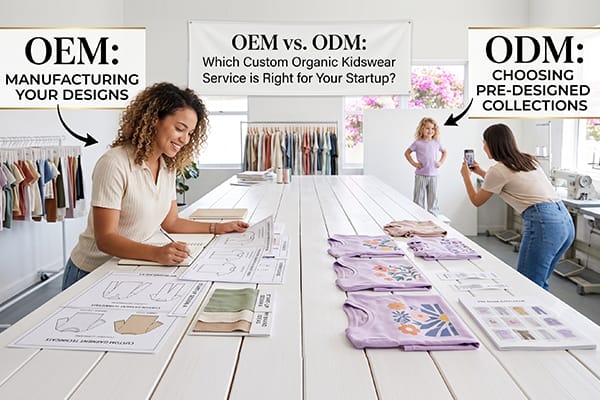
 # OEM vs. ODM: Which Custom Organic Kidswear Service is Right for Your Startup?
A custom organic kidswear service can feel confusing when you are building your first collection. You may have ideas, sketches, or reference photos, but you may not know if they are enough for production. That uncertainty can delay sampling and increase mistakes. The solution is to understand whether OEM or ODM fits your current stage.
OEM is right if your startup already has complete product specifications, including tech packs, size charts, artwork, fabric direction, color references, labels, and packaging details. ODM-style support is better if you only have concepts, moodboards, reference images, or incomplete product decisions. The best custom organic kidswear service depends on production readiness.
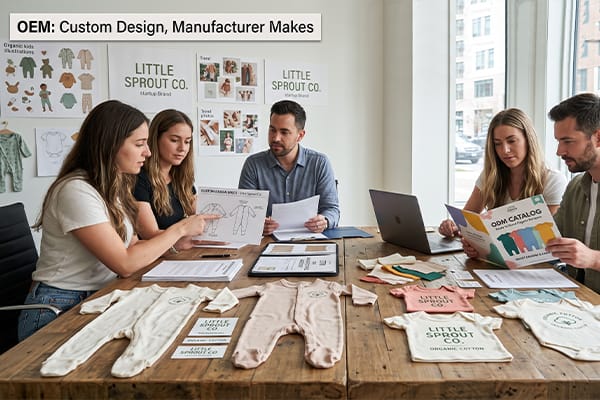
I often see startup founders ask about OEM vs. ODM before they ask about fabric or price. That question is useful because it shows where the real challenge sits: not only in manufacturing, but also in turning a brand idea into a clear, safe, and producible children’s garment.
What Does a Custom Organic Kidswear Service Mean in OEM vs. ODM?
Many startups feel stuck because “OEM” and “ODM” sound like factory language. The problem is that choosing the wrong path can create slow sampling, unclear quotations, and poor fit results. A simple definition helps you avoid wasted time before you contact a kids clothing factory.
OEM means the manufacturer produces according to your complete specifications. ODM means the manufacturer gives development support to help turn your ideas into producible specifications. In a custom organic kidswear service, OEM works best for production-ready brands, while ODM support works best for startups with incomplete product details.
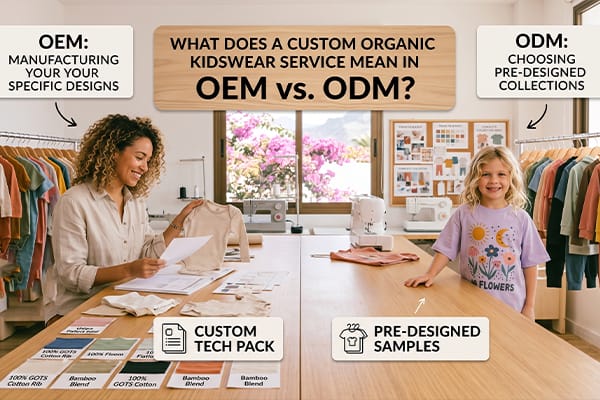
The simple difference between OEM and ODM
I usually explain OEM and ODM with one question:
“Do you already know exactly what you want us to make?”
If the answer is yes, you are likely closer to OEM manufacturing. If the answer is “I have references, but I need help finalizing the fabric, fit, printing, and size details,” you probably need ODM-style development support first.
Here is a practical comparison:
| Item | OEM Custom Organic Kidswear | ODM-Style Development Support |
|---|---|---|
| Best for | Brands with complete files | Brands with concepts or references |
| Main input from brand | Tech pack, specs, artwork, labels | Moodboard, reference photos, rough ideas |
| Manufacturer role | Execute, sample, produce, inspect | Help define garment details before production |
| Design ownership | Usually brand-led | Usually developed from brand direction |
| Speed | Faster if files are clear | Slower because development decisions are needed |
| Risk | Lower if specs are accurate | Lower than guessing alone, but needs more discussion |
OEM is not “better” than ODM
Some founders assume ODM is more advanced because it sounds more creative. I do not see it that way. OEM and ODM are both valid, but they solve different problems.
OEM is powerful when your brand has already invested in product development. You may already have:
- A full tech pack
- A graded size chart
- Finished artwork files
- Pantone color references
- Fabric composition targets
- Label and packaging artwork
- Clear target market requirements
In that case, a manufacturer should focus on accurate execution. The value is not in changing your idea. The value is in sampling correctly, controlling shrinkage, checking color fastness, following child safety expectations, and delivering stable bulk production.
ODM support is useful when your product is still forming. Maybe you want an oversized organic cotton T-shirt, bamboo-cotton loungewear, or a streetwear-inspired kids hoodie. You know the feeling, but not the measurements, construction, fabric weight, or print method. In that case, the supplier helps translate the concept into a garment that can be sampled and quoted.
At Taian Lianchuang Textile Co., Ltd., I often see this early-stage question during startup inquiries. The founder may think they are asking for production, but the real need is product clarification. That is why I usually start by checking whether the brand has a tech pack, size range, fabric direction, artwork, MOQ expectation, and packaging plan.
When Is OEM the Right Custom Organic Kidswear Service for Your Startup]When Is ODM Support the Better Custom Organic Kidswear Service?
A startup may choose OEM too early because it wants to look professional. The problem is that OEM requires clear instructions. If the files are missing, the factory must guess, and guessing can create fit issues, wrong fabric choices, or inaccurate quotations.
OEM is the right custom organic kidswear service when your brand has production-ready files. You should already know the garment style, size specifications, organic or sustainable fabric direction, colors, artwork placement, trims, labels, packaging, and target-market requirements. The manufacturer then focuses on sampling, production, and quality control.
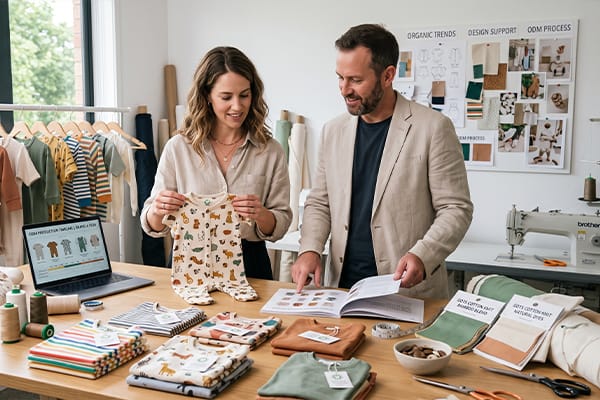
What a production-ready OEM inquiry includes
When I review an OEM inquiry, I look for details that reduce uncertainty. A strong OEM request usually includes the following:
Tech pack
- Flat sketches
- Construction notes
- Stitching details
- Print or embroidery placement
- Measurement points
Size chart
- Size range, such as 2Y–8Y or 3M–24M
- Body length, chest, sleeve, waist, hip, inseam
- Tolerance expectations
Fabric direction
- Organic cotton, bamboo, hemp, linen, lyocell, or blends
- Fabric weight, such as 180gsm jersey or 320gsm fleece
- Stretch, hand feel, and shrinkage expectations
Color requirements
- Pantone references
- Lab dip expectations
- Solid dye, yarn dye, garment dye, or wash effect
Artwork files
- AI, PDF, PSD, or high-resolution print files
- Print size and placement
- Screen printing, digital printing, puff print, embroidery, or appliqué notes
Branding and packaging
- Neck labels
- Care labels
- Hangtags
- Barcode stickers
- Polybags or paper packaging
- Carton marks
Compliance and market needs
- Destination country
- Children’s apparel safety expectations
- Labeling language
- Test report requirements if needed
Why OEM can be efficient for ready brands
OEM can be faster because the decision-making is already done. If your size chart, artwork, fabric, and packaging are clear, the manufacturer can move into sample development more directly.
For example, a startup may send an oversized kids T-shirt tech pack with:
- 220gsm organic cotton jersey
- Dropped shoulder fit
- Ribbed neckband
- Screen print at front chest
- Woven neck label
- Care label with fiber content
- Kraft hangtag
- Size range from 2Y to 10Y
That inquiry is much easier to evaluate than a message saying, “I want organic kids T-shirts like this photo.” Both are valid starting points, but they need different services.
OEM still needs technical checking
Even with complete files, I do not recommend treating OEM as a copy-and-paste process. Organic kidswear has special details that still need review.
A manufacturer usually checks:
- Fabric shrinkage: Organic cotton can shrink after washing if it is not controlled.
- Color fastness: Children’s garments must hold color during washing and rubbing.
- Print durability: Water-based prints, puff prints, and digital prints behave differently.
- Seam strength: Kids move, stretch, crawl, and play.
- Label comfort: Scratchy labels can cause complaints.
- Needle detection: Many children’s garment factories include final safety checks.
OEM works best when the brand brings clear direction and the supplier brings manufacturing discipline. In this case, a reliable kids wear factory does not need to redesign the collection. It needs to execute the collection carefully.
When Is ODM Support the Better Custom Organic Kidswear Service?
Many startup founders begin with inspiration, not specifications. That is normal. The problem is that reference photos do not tell a factory the fabric weight, measurement tolerance, stitching method, print technique, or packaging details. Without development support, the sample can miss the brand’s real vision.
ODM support is the better custom organic kidswear service when your startup has ideas but not full specifications. If you have moodboards, reference images, rough sketches, or general fabric preferences, an ODM-style process helps define materials, fit, construction, artwork methods, labels, and packaging before bulk production.

ODM support starts with product clarification
I usually see ODM-style needs when a founder says something like:
- “I want a minimal organic babywear collection.”
- “I like oversized streetwear silhouettes for kids.”
- “I have a logo, but I need help choosing the garment style.”
- “I want bamboo pajamas, but I do not know the best fabric weight.”
- “I have photos from Pinterest, but I need my own private-label version.”
These are not weak inquiries. They are simply earlier-stage inquiries.
The first step is to clarify the product direction. A manufacturer may ask:
| Question | Why it matters |
|---|---|
| What age range do you want? | Babywear, toddlerwear, and kidswear use different fit logic. |
| What season is the collection for? | Fabric weight and garment construction change. |
| What market will you sell in? | Labeling, testing, and compliance expectations differ. |
| Do you prefer oversized or regular fit? | Measurements and grading must match the brand style. |
| What is your target retail price? | Fabric and production choices must support the business model. |
| What MOQ can you start with? | Fabric sourcing and print methods depend on volume. |
ODM does not mean free brand design
This point matters. ODM-style support does not mean the factory builds your entire brand for free. It also does not guarantee sales. It means the manufacturer helps make your product idea technically possible.
ODM support may include:
- Suggesting fabric options
- Recommending practical garment construction
- Adjusting fit based on sample feedback
- Advising on print or embroidery methods
- Helping simplify complex designs for production
- Creating a sample based on reference direction
- Supporting private-label trims and packaging decisions
However, the brand should still lead the creative identity. Your startup should decide the aesthetic, target customer, price level, and collection mood.
Organic kidswear makes ODM decisions more complex
ODM for organic children’s clothing is not only about style. It also includes sustainability, comfort, and safety.
For example, if you want a baby romper, the fabric must feel soft, breathe well, and survive repeated washing. If you want a kids hoodie, the fleece must balance warmth, shrinkage, printability, and durability. If you want pajamas, the market may have more specific flammability or safety expectations depending on where you sell.
Common fabric options include:
- Organic cotton jersey: Soft, breathable, widely used for T-shirts and babywear.
- Organic cotton rib: Stretchy and useful for bodysuits, leggings, and cuffs.
- Bamboo-cotton blends: Smooth hand feel and good drape.
- Hemp-cotton blends: Stronger texture and more natural appearance.
- Lyocell blends: Soft, breathable, and suitable for premium basics.
- Linen blends: Lightweight and textured for summer styles.
ODM support helps you avoid choosing fabric based only on trend words. “Organic” is important, but the garment also needs the right weight, stretch, finish, dyeing method, and end use.
That is why, in many startup inquiries, I ask for reference images and then discuss fabric behavior. A photo may show a relaxed T-shirt, but the final look changes if the fabric is 160gsm, 220gsm, or 280gsm. Small technical choices can strongly affect the final product.
How Should You Self-Diagnose Before Contacting a Custom Organic Kidswear Service?
A startup can lose time when it contacts a supplier without knowing what information is missing. The problem is not that the idea is bad. The problem is that the manufacturer cannot quote, sample, or plan production accurately without enough details.
You should self-diagnose by checking whether your product details are complete, partly complete, or still conceptual. If you have tech packs, artwork, size charts, fabric choices, labels, and packaging, you are ready for OEM. If you only have references and ideas, you need ODM-style custom organic kidswear service support.
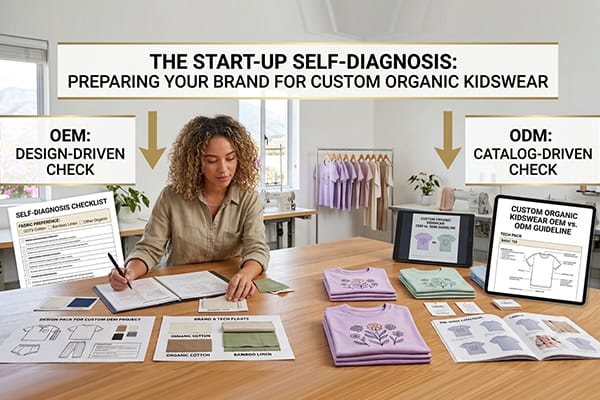
The startup readiness checklist
Before you contact an organic kidswear manufacturer, I suggest you review this checklist honestly.
| Readiness Area | Ready for OEM | Needs ODM Support |
|---|---|---|
| Product style | Final sketches or tech pack | Reference images only |
| Fit | Size chart and measurements | General idea like “oversized” |
| Fabric | Composition and weight selected | Unsure between cotton, bamboo, or blends |
| Color | Pantone references ready | Mood colors only |
| Artwork | Finished print files | Logo or rough concept only |
| Labels | Neck/care label artwork ready | Need private-label guidance |
| Packaging | Packaging specs ready | Not decided yet |
| MOQ | Quantity per style/color known | Need factory advice |
| Compliance | Target market confirmed | Unsure what documents are needed |
If most items fall in the left column, OEM is likely suitable. If many items fall in the right column, you should not feel discouraged. You simply need development support before production.
The questions I ask during early inquiries
As a manufacturer, I usually start with practical questions. These questions protect both sides because they reduce misunderstanding.
Here are the questions I commonly ask:
What products do you want to develop?
T-shirts, hoodies, rompers, pajamas, leggings, dresses, or full sets all need different production planning.What age range and size range do you need?
A baby 6M romper and a 10Y oversized hoodie follow very different pattern logic.Do you have a tech pack or only reference images?
This tells me whether the inquiry is OEM-ready or needs ODM-style development.What fabrics do you prefer?
Organic cotton, bamboo, hemp, linen, lyocell, and blends each behave differently.What printing or decoration do you need?
Screen printing, digital printing, puff printing, embroidery, and appliqué have different costs and minimums.What branding do you need?
Private label production usually includes neck labels, care labels, hangtags, and packaging.What is your target order quantity?
MOQ affects fabric sourcing, dyeing, printing, and price.Where will you sell the garments?
North America, Europe, Australia, and the Middle East can have different expectations for labeling and compliance.
Why honest readiness saves money
Some founders worry that admitting they do not have a tech pack will make them look unprofessional. I do not think that is true. In fact, it is more professional to say, “I have references and need development support,” than to send incomplete information and expect an accurate production quote.
Clear readiness helps the supplier choose the right process:
- OEM path: Quotation → sample → revisions → approval → bulk production
- ODM-style path: Concept review → fabric and fit discussion → sample brief → sample → revisions → approval → bulk production
Both paths can lead to custom organic kidswear. The difference is where the work begins.
If you are a startup, your goal is not to sound like a large brand. Your goal is to give the manufacturer enough information to help you properly. A good organic kidswear supplier should be able to tell you what is missing and what can be confirmed during sampling.
What Organic Kidswear Details Matter Beyond OEM vs. ODM?
Many founders focus only on the service model, but the garment details matter just as much. The problem is that “organic kidswear” can sound simple, yet children’s clothing has fabric, dyeing, printing, trims, comfort, and compliance considerations that affect every sample.
Beyond OEM vs. ODM, a custom organic kidswear service should consider fabric sourcing, dyeing, printing, trims, labels, packaging, safety checks, and target-market expectations. Organic cotton is only one option. The full development path must match the garment type, age range, brand positioning, and sales market.
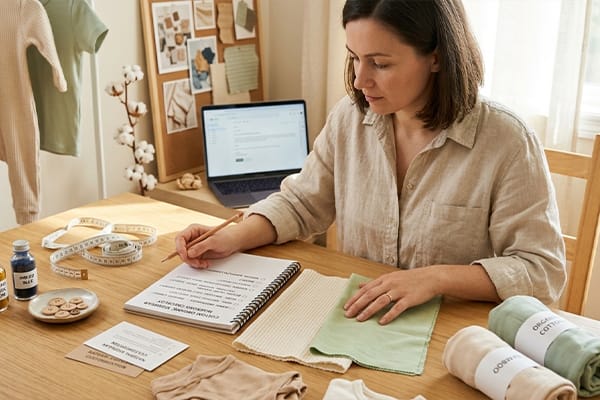
Organic fabric is the starting point, not the whole story
Organic cotton is popular for children’s apparel because it is soft, breathable, and familiar to consumers. However, it is not the only sustainable material used in modern kidswear.
Depending on the garment, a brand may consider:
| Fabric | Common Use | Key Consideration |
|---|---|---|
| Organic cotton jersey | T-shirts, bodysuits, tops | Weight and shrinkage control |
| Organic cotton fleece | Hoodies, sweatpants | Brushing, warmth, and pilling |
| Bamboo-cotton blend | Pajamas, loungewear | Softness and drape |
| Hemp-cotton blend | Casualwear, natural styles | Texture and garment structure |
| Linen blend | Summer sets, shirts, dresses | Wrinkle and hand feel |
| Lyocell blend | Premium basics | Smoothness and stability |
A custom organic kidswear project should also define the fabric weight. For example:
- 160–180gsm jersey may work for lightweight summer tees.
- 200–240gsm jersey may suit premium T-shirts.
- 280–360gsm fleece may work for hoodies and sweatshirts.
- Rib fabrics may need stretch recovery testing for cuffs and leggings.
Dyeing and printing need careful choices
Organic children’s clothing often uses softer, cleaner branding. But printing and dyeing still need technical planning.
Common options include:
- Pantone dyeing: Good for brand color consistency.
- Garment dyeing: Creates a washed, relaxed look, but shrinkage must be managed.
- Water-based printing: Soft hand feel and common for kidswear.
- Screen printing: Strong for solid graphics and larger quantities.
- Digital printing: Useful for detailed artwork and full-color prints.
- Puff printing: Trendy for streetwear-inspired graphics, but needs testing.
- Embroidery: Premium feel, but stitch density matters for comfort.
- Appliqué or patchwork: Strong visual effect, but more complex production.
I have seen founders choose a print method because they like the look, then later discover it affects price, MOQ, or hand feel. That is why the print method should match the age group and garment purpose. A heavy embroidery on a baby bodysuit may not be comfortable. A puff print on a toddler T-shirt may need durability testing. A full-print pajama set may need special attention to color fastness.
Trims, labels, and packaging affect the finished brand experience
Private-label kidswear is not complete when the garment is sewn. The brand experience also includes trims and packaging.
A startup may need:
- Main neck label
- Size label
- Care label
- Hangtag
- Woven patch
- Printed logo
- Branded buttons or snaps
- Custom polybag or paper bag
- Carton labels
- Barcode stickers
For children’s clothing, comfort matters. A beautiful woven neck label may still be a problem if it scratches the child’s neck. Some brands choose printed neck labels for T-shirts and pajamas because they feel smoother. Others prefer woven labels for premium outerwear.
Packaging also affects cost and sustainability. Some brands want compostable bags, paper belly bands, or minimal plastic. These choices should be discussed before bulk production, not after samples are approved.
Compliance depends on the market
I avoid giving legal advice because requirements can change and depend on product type and destination market. However, manufacturers usually need to know where the garments will be sold.
Target-market expectations may affect:
- Fiber content labels
- Country of origin labels
- Care instructions
- Tracking labels
- Chemical safety testing
- Flammability expectations
- Small parts safety
- Drawstring safety
- Needle detection
This is especially important for babywear, sleepwear, hoodies, and garments with cords, snaps, buttons, or decorative parts.
A professional manufacturing discussion should include compliance early. It is easier to adjust a design before sampling than to redesign after bulk production planning. That is one reason I believe OEM vs. ODM is only the first decision. The deeper decision is whether your product details are complete enough for safe, consistent, and market-ready manufacturing.
Frequently Asked Questions
Is OEM cheaper than ODM for organic kidswear?
OEM can be more cost-efficient when your files are complete because the manufacturer spends less time defining the product. ODM-style support may involve more development work, sample discussions, and revisions. However, the final cost depends on fabric, quantity, printing, trims, packaging, and garment complexity.
Do I need a tech pack before contacting a kidswear manufacturer?
You do not always need a tech pack, but you should be honest about what you have. If you have a tech pack, you are closer to OEM. If you only have reference images, you can still contact a manufacturer for ODM-style development support and sample planning.
Is organic kidswear only made from organic cotton?
No. Organic cotton is common, but sustainable kidswear may also use bamboo blends, hemp blends, linen, lyocell, and other eco-friendly materials. The right fabric depends on the garment type, season, hand feel, stretch, durability, and target price.
What information should I send for a private-label organic kidswear quote?
You should send product photos or tech packs, size range, fabric preference, colors, artwork, label needs, packaging requirements, order quantity, and target market. These details help the manufacturer judge whether you need OEM production or ODM-style development support.
Can a startup begin with low MOQs for custom kidswear?
Many startups ask for low MOQs, and some manufacturers can support flexible starting quantities. However, MOQ depends on fabric availability, custom dyeing, printing method, trims, and packaging. Stock fabrics and simpler designs usually make small-batch production easier.
Conclusion
The right custom organic kidswear service depends on your startup’s production readiness. Choose OEM if you already have tech packs, size charts, artwork, fabric direction, labels, and packaging details. Choose ODM-style support if you have ideas, references, and incomplete specifications. Both paths can work when the process is clear. If you are planning custom organic children’s apparel, you can send your tech pack, reference images, fabric requirements, size range, artwork, and packaging needs to Taian Lianchuang Textile Co., Ltd. for a practical manufacturing evaluation.